
Convert Industrial Engineering into Measurable Productivity & Throughput
A structured Industrial Engineering system that connects operation methods, standard time (SMV), line capacity, manpower, and material flow directly to shop-floor profitability.
Productivity & Daily Output
Sustained line output uplift achieved through line balancing and method re-engineering.
Reduction in MMR Ratio
Eliminating redundant helpers and manual line feeders through smart workstation flow.
Lower In-Line WIP
Compressing bundle cycle times and preventing choke points between critical operations.
SMV & Costing Accuracy
Scientific minute standards eliminate delivery delays and order undercosting.
Why Apparel Factories Underperform
Factories often possess adequate machinery and manpower but fail to realize their true capacity because standards are weak, lines are unbalanced, and improvement actions are not sustained.
Unreliable or Inconsistent SMV Standards
Standard Allowed Minutes based on guesswork or crude stopwatches create friction between merchandising, planning, and the sewing floor, causing unrealistic commitments and disputed line targets.
Unbalanced Lines & Excess WIP Accumulation
Without pitch diagrams and tactical operator allocation, lines become choked with WIP bundles at critical operations while downstream operators sit idle waiting for pieces.
Inefficient Methods & Workplace Layout
Operators waste up to 25% of cycle time on awkward reaches, repetitive repositioning, unnecessary fabric folds, and poor bin presentation that drains operator energy and speed.
High Man-to-Machine Ratio & Support Bloat
Excess helpers, line-feeders, and quality checkers are added to mask underlying inefficiencies, driving up overhead costs without delivering higher line throughput.
What We Deliver: 6 Integrated IE Disciplines
A comprehensive, facts-driven Industrial Engineering framework tailored for high-speed apparel cutting, sewing, and finishing lines.
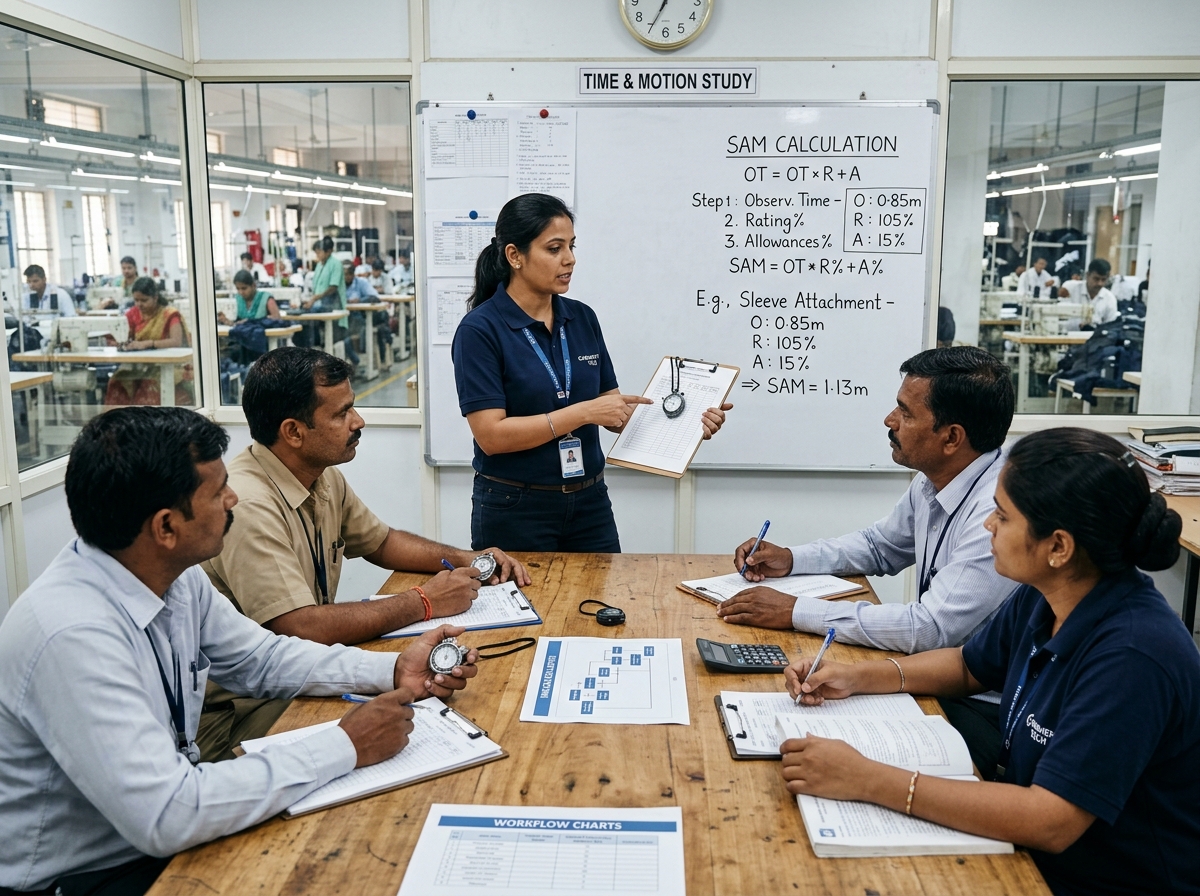
Work Measurement & Standards
Replace guesswork with scientific, indisputable standard times built from method-verified observation and PMTS/GSD logic.
- Cycle time analysis, video study & PMTS alignment
- Scientific allowances (personal, fatigue & machine delay)
- Master standard-capacity & SMV database repository
Capacity & Resource Planning
Convert buyer order volumes into exact machine loading matrices, operator skill requisitions, and optimized Man-to-Machine ratios.
- Product-wise machine loading & attachment planning
- Line-wise manpower budgeting & MMR rationalization
- Multi-skilling matrix linked to operation complexity
Method & Workplace Engineering
Re-engineer how operations are performed. Eliminate unnecessary fabric turns, optimize operator reaches, and integrate low-cost automation.
- Motion economy principles & ergonomic sewing station design
- Custom folders, binders, guides & pneumatic cutters
- Synchronized two-handed pickup and positioning motions
Line Balancing & Flow Optimization
Eliminate bottlenecks and bundle starvation by balancing work content across all operations to align perfectly with takt time.
- Pitch diagrams & scientific operator-to-operation allocation
- Bottleneck relief through sharing, de-skilling & sub-assembly
- WIP standard norms & real-time hourly production pacing
Layout & Material Movement
Streamline bundle logistics, minimize transit handling, and configure modular lines for single-piece flow or fast progressive bundle systems.
- Process flow engineering & line configuration (Straight vs. U-line)
- Point-of-use material presentation & trolley design
- Travel distance reduction between cut storage, sewing & trim
IE Organisation & Capability Building
Transform IE from a passive clerical reporting function into an active shop-floor engineering force that drives daily kaizen and accountability.
- Clear IE roles, standard operating procedures (SOPs) & toolkits
- Intensive training in method study, line setting & problem-solving
- Daily hourly reviews & cross-functional Gemba audit mechanisms
The 5-Step IE Transformation Path
We build the system from verified facts, translate findings into redesigned operations, and establish management routines that sustain the gains.
Diagnose & Baseline
On-floor diagnostic assessment. We establish the performance baseline and quantify hidden capacity, productivity, and flow losses.
Prioritise Opportunities
Select highest-impact opportunities by product category, critical processes, line constraints, and quick-win operator stations.
Design Solutions
Develop improved motion-efficient methods, robust SMV standards, optimized line layouts, staffing budgets, and hourly control systems.
Pilot & Implement
Test solutions on model lines with live production. Hands-on coaching of supervisors and operators, followed by factory-wide scaling.
Govern & Sustain
Embed daily hourly reviews, regular IE audits, operator skill matrices, and line-level KPI ownership into weekly management routines.
Unlock the Factory Capacity You Already Own
Whether the requirement is an IE diagnostic, model-line implementation, or factory-wide capability transformation, Cent Edge converts analysis into measurable shop-floor execution.
Higher Productivity & Line Efficiency
Achieve a 15–25% uplift in daily pieces produced per operator across all active styles.
Improved Throughput & OTIF Delivery
Shorten manufacturing cycle time, meeting tight buyer shipment dates with reliable On-Time In-Full metrics.
Optimized Man-to-Machine Ratio
Streamline auxiliary helpers and support staffing, lowering total labor cost per standard garment.
Lower WIP & Smoother Flow
Reduce in-process bundle piles by up to 30%, freeing up floor space and slashing soilage/damage risks.
Reliable Standards for Costing
Commit to orders with razor-sharp capacity and labor cost clarity, eliminating loss-making orders.
Strong Internal IE Capability
Build a skilled, accountable in-house IE department that drives continuous improvement independently.