
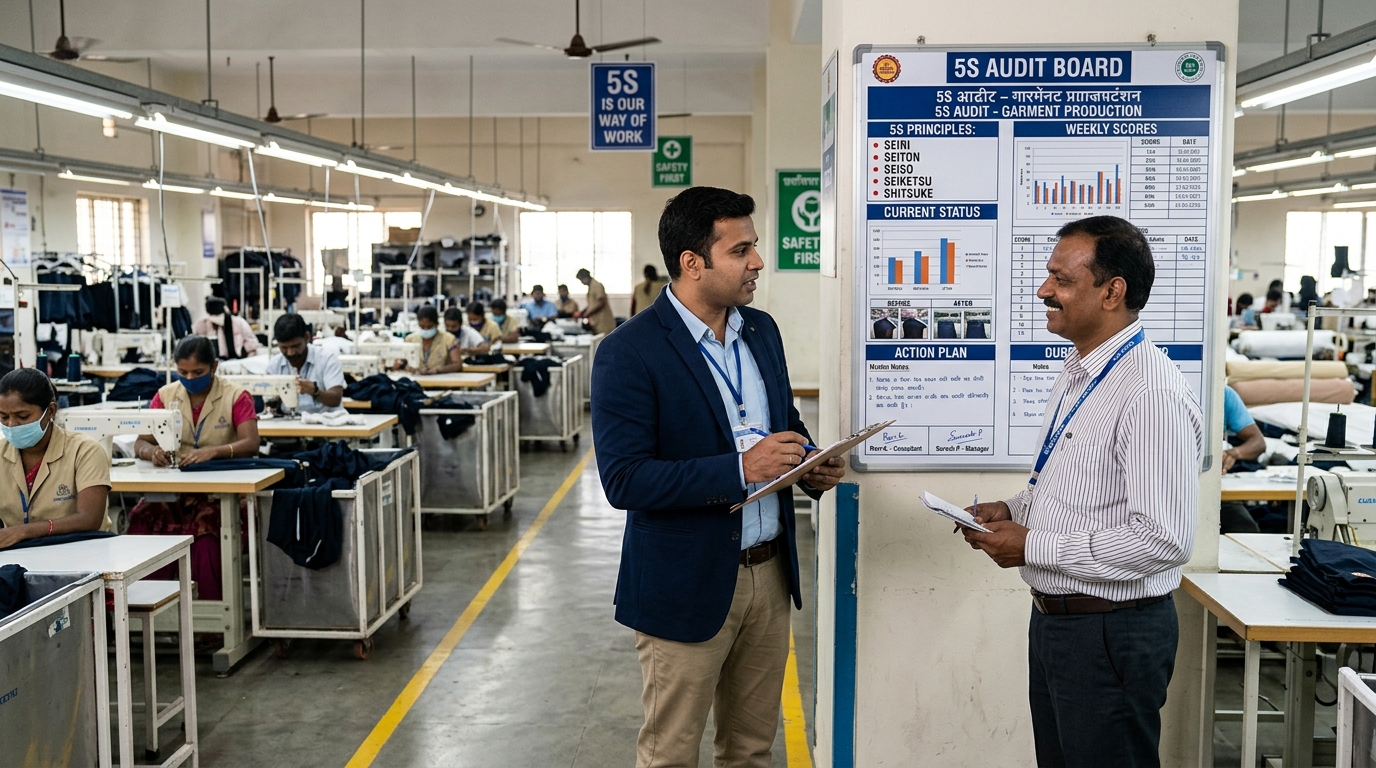
Most garment factory owners have experienced the “5S cycle”: consultants arrive, lines are painted, clutter disappears, photographs are taken, and within 60 days of the consultant leaving, the shop floor has reverted to its original chaotic state.
Why does this happen so consistently in apparel manufacturing?
1. Treating 5S as Housekeeping Instead of Flow
When 5S is treated merely as ‘cleaning the floor’, workers view it as extra work on top of their production quotas. Real 5S is about eliminating motion waste and enabling visual management. When tools are positioned within 12 inches of the needle point, the operator finishes seams faster and with less fatigue.
2. Lack of Fixed Ownership at the Station Level
Standardization requires that every square meter of the factory has a named custodian. Without individual ownership, maintenance becomes ‘everybody’s responsibility’—which means nobody’s responsibility.
3. Audits Without Consequences or Recognition
Audits must be weekly, objective, and tied to supervisory KPIs. When management stops reviewing audit scores on the weekly factory dashboard, floor teams immediately recognize that priorities have shifted.
The Cent Edge Sustenance Model
At Cent Edge, we never implement 5S without embedding a permanent internal governance council, standard visual checklists, and train-the-trainer capability transfers.